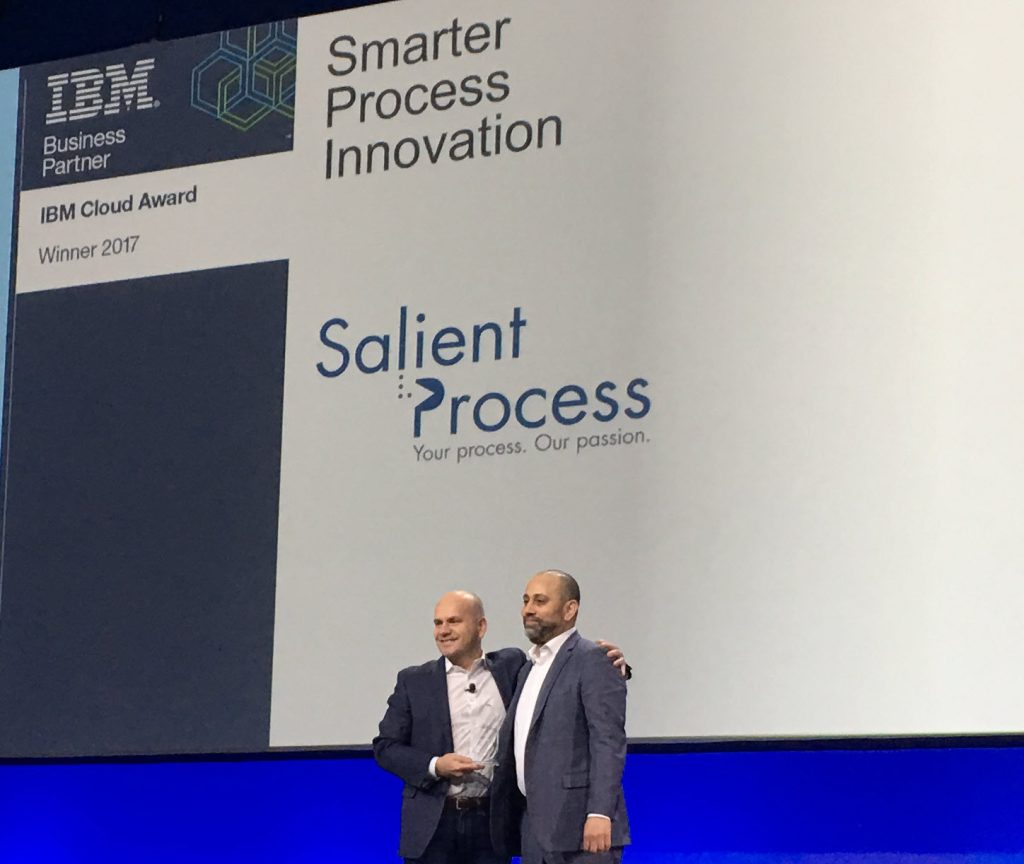
This weekend at IBM Interconnect, Salient Process was announced as the winner of the IBM 2017 Smarter Process Innovation partner of the year award.

It is very exciting for us to win this award, especially since we were a finalist for the Smarter Process award in 2016. It acknowledges our team’s incredible dedication to finding innovative ways to solve our customer’s Process Transformation challenges. That team includes our customers, partners, and IBM as they all push us to find new Smarter Process innovations and solutions. It is quite an honor for us to have been in business only five short years and already be on the podium at Interconnect winning an award highlighting our superior solutions for IBM Smarter Process. This adds to our string of successes over the past year due to our dedication to Process Transformation, including being named by Forrester as one of the twelve Digital Process Automation service providers that matter, and IBM purchasing Salient’s SPARK UI Toolkit.

We will continue to provide new innovations to the market, including our latest SPARK Toolkits: Ignition and UI Migration. Salient’s purpose as a company is to enable organizations to focus on higher level thinking. Every innovation we undertake is fundamentally guided by this purpose and philosophy. We believe our innovations, along with IBM’s unmatched suite of Smarter Process solutions, give organizations the best possibility of enabling the knowledge workers in their processes to rise above mundane and non-value-adding work to focus on higher level thinking.

So, keep an eye out for more innovations to come from us. And, if you are a smart, experienced, motivated software engineer looking to come work for a proven innovator, we are hiring. As you can see from the job description, you better bring your “A game”; then again, you’ll be working with a bunch of A-players, so you should fit in just fine.


In just about any business, one will encounter rules.  They may not necessarily be called “rules,” but they almost certainly exist in the business’s day-to-day operation.  These rules could be as complex as an insurance company using myriad factors to determine a policy quote, or a retail shop having a return policy.  While a small “mom and pop” store may not need any kind of computer system to process the occasional return, a Business Rule Management System (BRMS) is invaluable for managing the complex policies of larger enterprises, especially if rule processing needs to be understood or administered by business users as well as IT.

What a Business Rule Is

A business rule can ensure that day-to-day operations are handled in the best way depending on all the relevant factors for each business situation.  An example can be as basic as “If the status of a customer is gold, then the customer is eligible for a room upgrade” or far more complex, using multiple factors in different combinations to make a single decision.  An airline could make its less expensive fare restrictions based on time of purchase, travel period, origin and destination, whether the itinerary has a stopover or Saturday night stay, and perhaps some astrological occurrence – just for good luck.

Business rules are designed to be flexible so they can be used in nearly any industry.  If the business entities can be modeled (e.g. a customer has an age, a gender, an address, etc) and business policies can be expressed using these models, a BRMS can be used to improve the consistency, transparency, and agility of business operations.

What a Business Rule Isn’t

Of course, every tool is made for a specific purpose.  While a BRMS is great for processing business rules, there are still situations where other options should be considered.  For example, you could have a “rule” like this:

If the database is down, then display the error message “Cannot display this page, please try again later.”

Yes, a rule could be created for this but unless the action to be taken when the database is down is considered a business decision, a BRMS would not usually be involved in generating an error message.

Another example could be a statement like this:

Increase customer loyalty by giving more benefits to loyal customers.

This is certainly something you may hear in a department driven by the business but ultimately it is more of a strategy than a rule.  However, specific rules guiding daily operations could certainly be written to implement that strategy.

Keeping the ‘Business’ in Business Rule Management System

When properly used, a BRMS will maximize collaboration between people in the business and IT areas of an organization.  Because these departments will use different tools and terminology to perform their work, it is important to choose a BRMS that emphasizes the following features to bridge that gap and manage distribution of responsibilities:

Vocabulary and Language: Business users will work with their own spoken language, such as English, and terms used in their industry.  While IT workers often read, write, and speak “code,” some people may not realize that IT users also communicate with one another in a spoken language, such as English.  A proper BRMS will maintain a standard set of vocabulary that is understood by both business users as well as IT.  This includes data models (“the age of the customer”) as well as how the data is used (“if the age of the customer is less than 21”).

In an international organization, there may be a need to use different spoken languages.  In those cases, the BRMS should be able to support translations of the business model to provide a clear understanding of rules for all users, without any language barriers.

Rule Execution Orchestration: Sometimes rules are only evaluated in certain situations.  For example, a mortgage may only need insurance rules performed if insurance is necessary.  It is important that everyone have access to this process just as well as the rules themselves to maintain agility and to ensure that there are no misunderstandings about when a rule will be executed.

Controlled Accessibility: Having business-friendly features is a moot point if the users have no easy way of accessing them.  A BRMS should have turnkey features to provide this, with additional configuration options to grant CRUD (Create, Read, Update, Delete) and other advanced permissions for any combination of groups, so that each user has the access necessary to do their job, while being restricted from areas and activities out of their scope.

Consult with us today!

As we invest time and energy into the different aspects of our lives, we can sometimes forget to analyze new information that could potentially bring us progress and success. Oftentimes, we simply “go with the flow” because everything seems to be going smoothly, and only struggle through adaptation when a large impediment to our prosperity becomes clearly visible. These impediments can become bigger and more detrimental to our goals if we cannot withdraw our targeted focus and evaluate all of the details available to us. Because of our limited focus, these barriers sometimes become too great to overcome; we can see a great example of this by looking at the history of a company called Blockbuster.

Many of us have heard the slogan “Make it a Blockbuster Night”, and have even rented movies from a Blockbuster near our home. The first Blockbuster store opened in 1985, and nearly 8 years later the company owned more than 3,400 stores. At its peak in 2004, Blockbuster was the leader in video rentals, owning 9,000 stores worldwide and bringing in a revenue of $5.9 billion. At the beginning of the 21st century, their progress slowed due to competitors like Netflix. Netflix started out as a DVD rental company, but grew to be a very progressive online streaming and on-demand video provider. Due to Blockbuster’s inability to keep up with online providers’ newer technology, as well as refusing to let go of their declining business model, web based companies were leaving them in the dust. By 2010, Blockbuster realized the race had been lost and declared bankruptcy.

An interesting part of this story is that Blockbuster had a chance to buy out Netflix for $50 million in 2000, but declined the offer. Their business was invested mostly in physical products, and their lackluster transition to online videos cost them everything in the end. If Blockbuster had evaluated earlier the need for this transition, and examined the average customer’s preference more thoroughly, they would have understood that they needed substantial change. Nobody can tell the future, but it is evident that Blockbuster’s fate would have been different if the company’s goals and directions, as well as business processes, had been adjusted to the radical shift in video rental technology. Blockbuster did not embrace the changes that could have kept them a leader in today’s video industry.

Companies are made up of teams, and these teams must work synchronously to move that company through the jungle we call “Business”. An organization benefits the most when the information traveling through it has been analyzed and accepted with a fresh mind. We at Salient Process believe that a continually prosperous team is a group of talented individuals that are able to efficiently analyze all of the details available to them, and to focus on the ones that matter most. We strive to give clients insight to potential obstacles that are not easily visible, and stand by a principle core value, “We are one.” We have realized that knowledge of the bigger picture can streamline the way to nearly perfect solutions, and consistent analysis of new information has helped us grow. The end of Blockbuster presents us with an example of a team that did not analyze new information correctly, and the failure to react correctly to their opponent’s progressive actions took its toll. We love to help companies streamline the way they do business, because it means that we can share information and optimize every activity that makes up their Business Process.

In the Business Process Management world, the way we manage our time and efforts reflects directly on our progress toward optimization. If we spend too much time on aging and sometimes impractical methods of implementing a solution, our potential goes down the drain. A quote by Rosa Luxemburg summarizes this state of mind very well: “Those who do not move do not notice their chains.” Our desire is to help progressive thinkers free themselves from the chains of slower development patterns and to embrace BPM Innovation. We all want to build solutions faster, to receive more out of our work, and to use software that doesn’t limit our potential. One of the main reasons that I love working at Salient is that everyone is constantly searching for improvements in their work, and that we embrace the mindset of a team that always moves forward. I have used a wide array of BPM development tools and have worked with many user interfaces, and every new tool’s pros/cons make me realize what great possibilities a tool like SPARK provides.

Whether you are in management or a developer, looking into SPARK will definitely change your perception of BPM Development. SPARK (https://salientprocess.com/salesforce-toolkit/) is a User Interface Toolkit offered by Salient Process that can accelerate BPM development by 4 times! The community version of this toolkit is available free of charge, and can be a great tool in helping you increase your interface building potential. By implementing new ways of accelerating development, we allow bigger and better opportunities to present themselves.

What will you do with this new information? Will you let the advancement of UI development tools be overlooked in your drive towards success, or will you embrace and experience SPARK’s amazing capabilities?

References:

www,businessinsider.com

www.thestreet.com

www.history.com

www.ibtimes.com

If you are going to be at IBM Interconnect 2016, please stop by and listen to and interact with Jared Michalec (our VP of Client Services) and Adobe describe their success in leveraging the Complex Event Processing component of the IBM Smarter Process suite of software.  Jared and team did a great job with Adobe in transforming how they do targeted marketing.  Details of session below:

Adobe Leverages Complex Event Processing Using IBM ODM Advanced to Help Upsell Products
When: Wednesday, February 24th (4:45 PM – 5:30PM)
Location: Reef Ballroom F – Mandalay Bay SOUTH

Adobe needed a sophisticated decision management platform to handle a new, complex, high-volume, cutting-edge marketing program. The organization wanted to detect and react to customer events (or missing events) to provide targeted, relevant messaging in order to expand the user’s use of the Adobe portfolio. IBM ODM Advanced not only provided the functionality they required, but did so in a matter of weeks. Come hear the story at this interesting and informative presentation and demonstration, in order to better understand how making decisions based on events and with better context is the future of business rule management.

Speakers:
Kevin Davis, Adobe Systems
Jared Michalec, Salient Process

Migrating Between BWL Accounts

When migrating between Blueworks Live accounts you have a couple of options. Blueworks Live allows you to export a Process in a variety of formats, some of which allow you to import into the destination account. This approach can be tedious depending on the size of your library and will force you to recreate the structure of your artifacts. In addition, you will lose much of the metadata that you enter above the Process level. Blueworks Live also supports copying a Space between two BWL accounts, and this is the approach that I recommend. However, there are two prerequisites you need to keep in mind when planning for a migration of this type.

Permissions

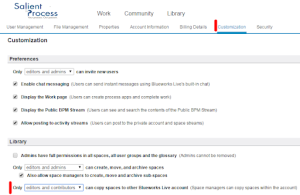
Administrators have permission to copy a Space from one account to another. In addition, if an administrator has granted editors and/or contributors permission in the Admin panel, then these users will be able to copy between spaces as well, granted that they are editors or contributors in the Space that is being copied.

Furthermore, make sure you have access to all artifacts that are children of the Space you are attempting to copy between accounts and that any child artifacts are active or they will not be copied. BWL will warn you if some child artifacts are not being migrated. Examples of these artifacts may be other spaces, processes, decisions or policies. Archived artifacts will not be copied.

Custom Properties

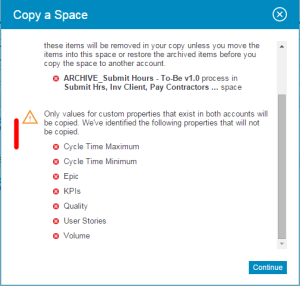
If you would like to retain your Custom Properties values between the BWL account you’re migrating from and the destination account, you will first have to recreate these properties manually in the destination account.

Other Notes

If you are worried that moving Spaces to another account means that it will no longer exist in the original account, don’t be! The way the terms “Move” versus “Copy” are used fit perfectly with how we are accustomed to them working. Copy will leave the source Space intact where it is, and make an exact copy of it (barring any concerns noted in the previous section) in the destination account.

Secondly, there is a tip that can speed up migration. Spaces work like folders: a Space can have nothing but processes in it, or a Space can have additional Spaces inside of it. When you move a Space, sub-Spaces are also moved. So, the fewer spaces you have at the top-level the quicker migration will be.

Step-by-step

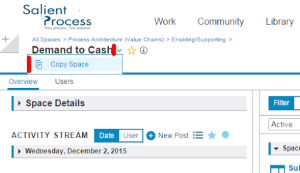
Once you have addressed the concerns above, you’re ready to begin copying. Navigate to the space you would like to copy. On the top left, there will be a small down arrow just to the right of the Space name. Click the arrow, then click “Copy Space”. In this example, “Demand to Cash” is the name of our Space.

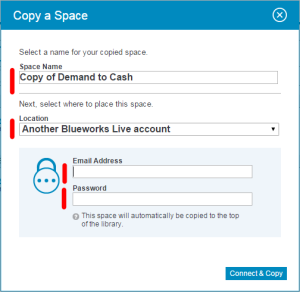
The “Copy a Space” pop-up menu will appear. Here you have the opportunity to rename the Space before it gets copied to the destination account. The default here will be “Copy of“ then your original Space name. Next, in the “Location” drop down, choose “Another Blueworks Live account” and enter the credentials for the destination account.

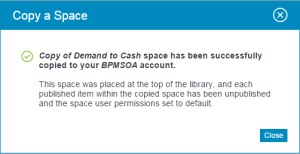
Once the Space has been successfully migrated, you’ll see another pop-up reconfirming that the Space you chose was migrated to the account that you pointed it to.

When is getting “fired” a reason to celebrate? When it is for the right reason and it was your ultimate goal anyway. To get to the crux of this belief of mine, and Salient’s, we have to go back to when I worked for Intel.


I was at Intel for seven years; the first four years in Business Intelligence, and the last three in the Business Process Management space. During that time, I can’t remember when exactly, I came to the opinion the ultimate goal of a software developer should be to create such great works of software that the software developer was no longer needed for that particular effort. If you build a great solution which runs without issues, you really aren’t needed anymore. Perfection can’t be improved upon. However, it can’t be achieved either, but it is good to aim high when it comes to goals; shooting for the moon almost guarantee s you’ll hit some stars. Of course, there is also the factor of technology constantly changing, but perfection is still a great goal to shoot for. Thus, this became my goal for any solutions I was involved in building. I would be “fired” because I had done such a great job I just wasn’t needed anymore. I wanted to be like the mythical Maytag Man.

When I started consulting for Lombardi (Lombardi was purchased by IBM in 2010 and became IBM BPM) back in 2008, I decided the same concept applied. My job was to not only build great solutions, but to enable the client to be able to continue building great solutions without me there. In other words, my work had to be repeatable and scalable. The key things with this are methodology and attitude. The attitude part is important because this has to be ingrained into a consulting company in order for this to be real. It cannot be something only one or two employees believe in, otherwise it will not work. The philosophy of the company overall must be one of enablement and that the goal of every engagement is to get the client to be able to “stand on their own two feet.”

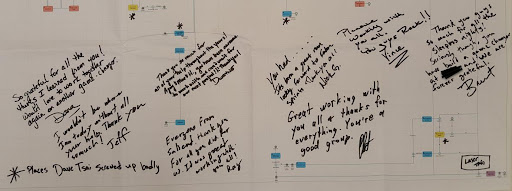
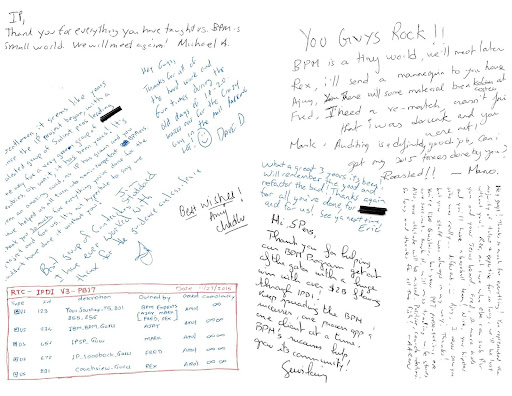
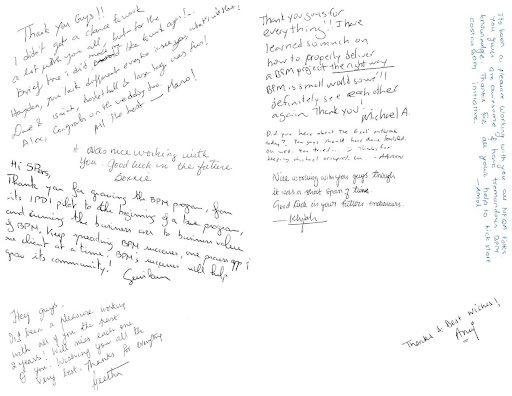
So, how does the title of this publication fit in with the content? Our largest client is now at the point where we have so enabled them they don’t need us anymore. Well, at least they need about 75% less people from Salient than they did at one time. This has happened gradually over time. Through our efforts at mentoring, developer and analyst shadowing, sending their resources through Salient’s Bootcamp, as well as their own commitment to hiring good people, the client is now at the point where they have a fully functioning Business Process Management Center of Excellence, and are completely self-sufficient other than some staff augmentation. You can see how happy there are/were with us by the cards they spontaneously signed and sent to us saying goodbye to the Salient Process team members working on their projects (some names/words have been crossed off to protect the identity of the client):

From their analysts:

From their development teams:

This is truly what Salient is about. Our client’s processes are our passion, and our purpose as a company is to enable organizations to focus on Higher Level Thinking. We want to enable you to the point that you give us a card(s) filled with wonderful farewells, and send us on our merry way, with the assumption you are fully capable of running your own Smarter Process programs at that point. While we may move on, the commitment to the process and improvement does not end, it is continued with the client. In addition to that, being “Fired” does not mean goodbye. We will remain a Strategic Partner with all our clients so we are available to assist them with any bumps in the road they will encounter in their Process and Decision Management journeys.