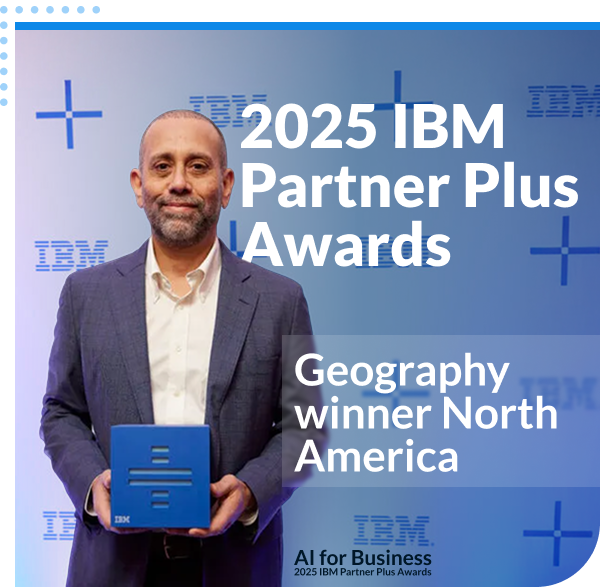
Every delayed result starts with a single enterprise platform.
No more fragmented point solutions. One platform orchestrates agents from OpenAI, Claude, Granite, and your own models. Deploy, govern, and scale them all from a single control plane. At Salient, we implement Orchestrate as the control layer that lets business users deploy agents in hours, not months, while IT maintains governance without becoming the bottleneck.
IBM's no-code Agent Builder, pro-code ADK, and Langflow prototyping give every team a path to a working agent. Business users start in minutes. Developers build complex integrations with Python workflows. Choose your model via AI Gateway: Granite, GPT, Claude, or Gemini.
No-Code Agent Builder
Guided flows and 400+ prebuilt tools. Business users deploy agents without writing a line of code.
Developer ADK and Langflow
Pro-code Python workflows and visual prototyping for complex custom agents and API integrations.
AI Gateway: Any LLM
BM Granite, OpenAI, Claude, Gemini, Mistral. No lock-in. Policy-governed from one place.
All your agents. One conversation.
watsonx.ai gives your teams access to IBM Granite, Llama, Mistral, and frontier models via Model Gateway. Tune any model on your enterprise data using prompt engineering, fine-tuning, or RAG. No model lock-in and no infrastructure scramble.
Model Gateway
IBM Granite, OpenAI GPT, Anthropic Claude, Meta Llama, Mistral. Choose and switch models without rebuilding your applications.
Tuning Studio
Fine-tune foundation models on your proprietary data for summarization, classification, extraction, and Q&A without large training budgets.
Prompt Lab and RAG
Engineer, test, and compare prompts. Connect models to enterprise knowledge bases for grounded, citation-backed responses.
Every decision. Logged. Defensible. Auditable.
watsonx.ai gives your teams access to IBM Granite, Llama, Mistral, and frontier models via Model Gateway. Tune any model on your enterprise data using prompt engineering, fine-tuning, or RAG. No model lock-in and no infrastructure scramble.
Model Gateway
IBM Granite, OpenAI GPT, Anthropic Claude, Meta Llama, Mistral. Choose and switch models without rebuilding your applications.
Tuning Studio
Fine-tune foundation models on your proprietary data for summarization, classification, extraction, and Q&A without large training budgets.
Prompt Lab and RAG
Engineer, test, and compare prompts. Connect models to enterprise knowledge bases for grounded, citation-backed responses.
These are the highest-ROI AI patterns we deploy by industry, each tied to measurable outcomes your operations team and CFO both recognize.
Invoice 3-Way Match (AP Automation)
AI reconciles purchase order, goods receipt, and vendor invoice. Clean matches close without a human touch. Exceptions route with context. AP cycle time drops from days to hours.
Typical outcome: 80% straight-through processing
Loan Origination and Document Processing
AI extracts, validates, and routes data from unstructured loan documents. Manual keying eliminated. Origination capacity scales without headcount. Every decision governed and auditable.
Example: 55% faster, 60% lower cost per loan
KYC and AML Screening Workflow
Automated watchlist checks, risk scoring, and case creation on customer onboarding. Full audit trail for regulatory defensibility. Compliance teams work exceptions only.
Typical outcome: 70% reduction in manual screening time
Regulatory Reporting Automation
Data aggregation, transformation, and report generation automated across systems. Reports timestamped, versioned, and submission-ready. Manual assembly risk eliminated.
Typical outcome: 90% reduction in manual report assembly
Claims Triage and Intelligent Routing
AI reads First Notice of Loss submissions from any channel, extracts incident type, severity indicators, fraud signals, and coverage match, then routes the claim to the right adjuster tier or automated track before any human opens the file.
15–30% cycle-time reduction
Underwriting Document Intelligence
Structured and unstructured submissions are read by AI that extracts risk-relevant data points, flags missing information, and cross-references external data sources. Underwriters receive a structured risk summary instead of raw documents.
Outcome: Submission handling time reduced by 60%, 40–60% faster submission intake.
Technologies: watsonx.ai
Churn Prediction and Retention Scoring
Models score every policy at renewal time for flight risk based on payment history, engagement signals, competitive pricing exposure, and life event indicators. High-risk policies route to proactive retention campaigns.
Outcome: 20-30% improvement in retention for at-risk policyholders when proactively engaged
Technologies: watsonx.ai
Property Risk Assessment from Unstructured Data
AI processes satellite imagery, inspection photos, weather history, and building permit records to generate property risk profiles for underwriting and claims validation. Human review focuses on edge cases.
Outcome: Underwriting accuracy improves. Inspection costs reduced by 30% through AI pre-screening
Technologies: watsonx.ai, watsonx.governance
Prior Authorization Criteria Matching
AI reads clinical notes and payer coverage guidelines simultaneously, extracting clinical evidence and mapping it against payer-specific medical necessity criteria. Submissions arrive complete the first time rather than being returned for missing documentation.
Outcome: 60% reduction in auth cycle time
Technologies: watsonx.ai, watsonx Orchestrate
Denial Reason Classification and Correction Intelligence
AI classifies denied claims by root cause: coding error, missing auth, eligibility mismatch, timely filing. For each denial category, correction logic is applied and supporting documentation is generated automatically. Resubmission rates improve because the fix targets the actual cause.
Outcome: 30% improvement in first-pass resolution on resubmission. Revenue recovery accelerates.
Technologies: watsonx.ai, watsonx Orchestrate
Provider and Specialist Matching Model
AI matches referred patients to in-network specialists using availability, distance, clinical specialty match, and insurance eligibility simultaneously. The model recommends the optimal match in seconds rather than requiring coordinators to work through provider directories manually.
Outcome: 50% reduction in referral cycle time
Technologies: watsonx.ai, watsonx Orchestrate
Clinical Documentation NLP and Routing
Natural language processing reads completed clinical notes after each encounter, extracts diagnosis and procedure information, maps to the correct coding and billing fields, and routes documentation to the right downstream system. Providers document in their natural workflow; AI handles the classification.
Outcome: 40% reduction in documentation time per provider
Technologies: watsonx.ai, watsonx Orchestrate
Predictive Maintenance to Work Order
Sensors on production assets feed a predictive model that detects degradation patterns before failure. When a threshold is crossed, AI automatically creates a prioritized work order in the CMMS, pulls the relevant maintenance procedure, checks parts availability, and notifies the technician.
Outcome: Unplanned downtime reduced by up to 20%
Technologies: watsonx Orchestrate, watsonx.ai
Quality Defect Detection to Supplier Correction
Computer vision on the production line flags non-conforming parts. AI classifies the defect type, traces the batch to its origin, generates a non-conformance report, and initiates a supplier corrective action request with evidence attached. No manual inspection routing.
Outcome: Defect escape rate drops
Technologies: watsonx Orchestrate, watsonx.ai
Supply Chain Exception Management
AI monitors purchase orders, shipment ETAs, and inventory levels in real time. When a disruption is detected (late delivery, stock-out risk, supplier issue), an orchestrated workflow identifies alternative sourcing options, calculates impact to production, and routes a decision package to the supply chain manager.
Outcome: Response time to supply exceptions drops from days to hours
Technologies: watsonx Orchestrate, watsonx.ai
New Product Introduction Documentation
Engineering submits design specs. AI extracts key parameters, generates draft SOPs, work instructions, quality control plans, and regulatory documentation aligned to the product category. Technical writers review and finalize instead of authoring from scratch.
Outcome: NPI documentation cycle compressed by 50%. Consistency improves across product lines
Technologies: watsonx Orchestrate, watsonx.ai
Hyper-Local Demand Forecasting for Replenishment
AI models combine POS data, weather, local events, promotional calendars, and supplier lead times to generate store-level and SKU-level demand forecasts daily. Replenishment orders are generated from the forecast rather than from reorder points set months ago.
Outcome: 30% fewer stockouts. 15% reduction in inventory carrying costs
Technologies: watsonx.ai, watsonx Orchestrate
Order-to-Cash Intelligence
AI extracts structured data from orders arriving in any format (EDI, email, portal, fax), validates pricing against active contracts and promotional agreements, flags discrepancies before fulfillment, and scores each order for credit risk. On the back end, cash application models match incoming payments to open invoices automatically, even when remittance information is incomplete or inconsistent. Deductions and short payments are classified by reason code and routed with context.
Outcome: 80% of orders and payments processed without manual intervention
Technologies: watsonx.ai, watsonx Orchestrate
Customer Return and Refund Processing
AI verifies purchase eligibility, classifies the return reason, and determines the most economical resolution path: full refund, exchange, store credit, or no-return refund where shipping costs exceed item value. Models trained on return history learn which resolution paths drive repurchase and loyalty versus which create friction. Fraud scoring runs in parallel to flag serial returners or policy abuse before the resolution is issued.
Outcome: Return resolution time drops from days to minutes
AI forecasts customer traffic by location and time of day, translates it into staffing requirements by role, and generates compliant schedules from employee availability data. Managers receive a schedule recommendation rather than building one from scratch against a spreadsheet.
Outcome: 60% reduction in scheduling time
Technologies: watsonx.ai, watsonx Orchestrate
RAG-Based Enterprise Knowledge Assistant
AI indexes the organization's internal knowledge base: policies, SOPs, product documentation, contracts, past case notes. Employees ask questions in natural language and receive answers with cited sources, replacing manual document searches.
Outcome: Employee time searching for information reduced by 50%
Technologies: watsonx.ai, Watson Assistant
Intelligent Document Extraction and Classification
AI reads incoming documents from any channel, classifies type, extracts key fields, validates completeness, and routes to the appropriate system or workflow. Replaces manual data entry across AP, claims, HR, compliance, and operations.
Outcome: Document processing cost reduced 60-80%
Technologies: watsonx.ai, watsonx Orchestrate
Summarization at Scale (Cases, Emails, Reports)
AI reads lengthy case histories, email chains, meeting transcripts, and reports and generates structured summaries in seconds.
An orchestrator AI receives an intent from an employee or customer, decomposes it into tasks, selects the right downstream agents and tools, and coordinates execution to completion. Multi-system tasks that previously required multiple teams complete in a single conversational interaction.
Outcome: Task completion time drops 50-70%
Technologies: watsonx Orchestrate, watsonx.ai
Turn AI Ambition into Measurable ROI
Accelerate enterprise AI adoption with secure, governed solutions powered by IBM watsonx.ai.
Orchestrate is built for speed. But speed fails if agents don't coordinate across your legacy systems, if watsonx.ai models aren't tuned on your data, or if you bolt compliance controls on after launch. We've spent 13 years wiring IBM BAW, watsonx, and governance tools together for regulated environments. We baseline your process, identify which workflows go no-code and which need watsonx.ai tuning, then architect Orchestrate to coordinate both across your actual systems. We stay live after deployment to track agent performance, refine models, and scale to the next workflow without rework. That's why our engagements move from pilot to production ROI in weeks.
We baseline your process, quantify every bottleneck, and identify where AI belongs before configuring a single agent. We never automate broken processes.
Outcome-Proven Delivery
KPIs locked before any agent is configured. Every engagement closes with a CLARITY Proof Pack, executive-validated, fundable, and referenceable.
Governance Built In From Day One
We design compliance into every workflow before build. Every AI decision logged, explainable, and defensible. Pharmaceutical, financial, and healthcare-grade from day one.
Deep IBM Ecosystem Knowledge
13 years of Gold Partner experience across BAW, CP4BA, ODM, and now watsonx. We know the roadmap before it ships. Your project never stalls on platform change.
Better document processing than OCR.
Traditional OCR chokes on complex formats, handwriting, and low-quality scans. Our approach uses generative AI on top of Business Automation Workflow to extract structured data from any document type. Up to 100% accuracy. Fractions of a penny per document.
No. Orchestrate integrates with Salesforce, SAP, Oracle, Microsoft 365, Workday, ServiceNow, and 80+ other platforms. Salient has connected it to legacy mainframes, homegrown ERPs, and older policy administration systems without replacing any of them. The platform is designed to work inside your existing stack, not on top of a replacement project.
Who build and manage the agent, IT or business?
Orchestrate is designed for both. Business users build with the no-code Agent Builder in minutes. Developers use the ADK and Langflow for complex custom agents and integrations. Both teams operate within the same platform and the same governance layer, so business teams move quickly and IT maintains control without being the bottleneck.
How does AI governance work in regulated industries?
Orchestrate includes AgentOps governance as a core feature. Every agent decision is logged, traceable, and auditable. Policy-based controls enforce compliance automatically and prevent unauthorized data access. In Salient's regulated-industry engagements, including healthcare and financial services clients, we define the governance architecture before any agent is built so that audit requirements are met from day one, not added later.
How quickly can we see a real outcome?
Our fastest deployment documented $46K in labor savings within two weeks of going live. A typical Salient engagement scopes for a documented, measurable KPI movement within four weeks. We start every engagement with a Roadmap Workshop where we map one process, identify the highest-ROI opportunity, and define the success criteria before any work begins.
What if the workflow we need is not in IBM’s prebuilt catalog’
IBM's 100+ prebuilt agents cover the most common enterprise workflows. For processes specific to your industry, legacy systems, or compliance requirements, Salient builds custom agents that connect Orchestrate to those realities. Our Roadmap Workshop helps determine which workflows are best served by catalog agents and which need custom builds before any investment is committed.
See where Orchestrate fits in your operation.
In 60 to 90 minutes, our watsonx Orchestrate specialists map one of your processes against Orchestrate's capabilities, identify quick wins, and define the scope and KPIs for a 45-day proof of value. No commitment required.