
Salient’s Podcast is coming soon!


Bots & Thoughts: The Digital Business Automation Podcast

Bots & Thoughts: The Digital Business Automation Podcast, created by Salient Process, is a podcast about all things digital automation. If you are a Director of Intelligent Automation, work within a Process Improvement team, or are a department leader looking to make life easier for you and your team members, this podcast is for you! In addition to the Host’s expert advisory editorials, you will hear from automation professionals and business leaders as they dissect their automation success stories, use cases, and lessons learned along the way. Every other week Jimmy Hewitt, Salient’s Sr. Automation Advisor, will be hosting discussions about Digital Business Automation, process improvement, productivity, efficiency, and more.

Listen to our pilot episode now!


Where are the other episodes?

Great question! This May, Salient Process will be kicking off season 1 of Bots & Thoughts: The Digital Business Automation Podcast. We will be launching not 1… not 2… but 3 episodes for you to dive into. We will be covering the basics of Digital Business Automation, and we will be welcoming our very first special guest on the show. We are so excited, and we can’t wait to share these episodes with you! Stay tuned as we will release the exact date when the time is closer.

What will the episodes be about?

Another great question! The start of our series will be covering the basics of Digital Business Automation, what it is today, and how it originally came to be! We want to make sure we define, categorize, and dissect this “catch-all” term for our audience before we jump into the show. We will be exploring in-depth topics like Capability and Process Mapping Standards from the APQC team and their Standard Process Frameworks, proper process mapping via BPMN2.0 notation, and more oddly specific topics within the world of Digital Business Automation.

Will there be guests on the show?

Absolutely! Our podcast will have 2 themes: solo and guest episodes. The solo episodes will be a short series of episodes (2-3 episodes in series) that will be about 10-15 minutes produced by our host Jimmy Hewitt, Salient’s Sr. Automation Advisor. At the end of each series, we will welcome a special guest onto the show to talk about their own automation journey and experiences. We will define case studies, discuss the ROI, how many manual hours were saved due to their automation implementation, etc. We really look forward to these episodes and hope you are too!

How often will we be releasing episodes?

Bi-weekly! Our goal is to release new content every other week. As of right now, we do not have a set day of the week that we will launch our episodes on, but we will let you all know when we are closer to May.

Upcoming episodes:

What is Hyperautomation
On this episode of Bots and Thoughts, your host Jimmy Hewitt, Sr. Automation Advisor, will be defining exactly what hyperautomation is. He will be introducing the 5 pillars of hyperautomation and what each particular automation capability looks like in today’s world. These automation capabilities are RPA (Robotic Process Automation), BAW (Business Automation Workflow), ODM (Operational Decision Management), ECM (Enterprise Content Management), and Capture Technology.
 

We just identified the 5 automation capabilities and defined what hyperautomation means. Now that we understand what hyperautomation looks like in 2022, let’s travel back in time to understand how these 5 different automation capabilities came to life. Stick around at the end… there might be a bonus section for you! 


 Special Guest Episode
 We cant give all of our secrets away! Stay connected with us on our socials and subscribe to our newsletter to find out who our special guest will be!

 We are so excited about this episode and hope you are too!


are there more episodes?

YES! Bots & Thoughts is officially on all podcast streaming platforms. Check it out now!

https://www.salientprocess.fm/

Have a topic idea? Let us know!

We would love to hear from you. This podcast is for you, and if you have something that you want to hear, we would love to know. This form is also a place for you to ask questions or get in touch with our Salient Process team. 

Submit a request for a podcast topic here❗


👉Subscribe to Bots & Thoughts: The Hyperautomation Podcast

👉Subscribe to our Spotify Here

👉Subscribe to our Apple Podcast

👉Subscribe to our Google Podcast Here


⏩Subscribe to Salient’s Monthly Newsletter Here 

🎤Be our next guest! Sign up Here

📲Contact our Podcast Host Here 

 

  ⏩LinkedIn

👉 Follow Bots & Thoughts on Here

👉 Follow Salient Process Here

👉 Follow our Podcast Host Here

  ⏩Youtube 

  ⏩Twitter 

🌐Learn more at Salient Process


RELATED CONTENT


More on Hyperautomation:

Hyperautomation Home Page

What is Hyperautomation?

Scaling Beyond RPA to Hyperautomation

North Star Methodology

More on Salient Process:

Salient Process Home Page

Bots & Thoughts: The Hyperautomation Podcast

Salient Process is a full-service digital business automation shop and proud IBM Automation business partner. To learn more about us at our website, request a free consultation with one of our expert automation advisors! We look forward to guiding you and your company along your own unique Hyperautomation journey.

Hyper the Holiday Elf


Author: Jared Michalec, VP of Client Services


This is a story about an elf named “Hyper”

While most of Santa’s elves are usually happy and productive, Hyper was feeling anxious. Everywhere he looked, Hyper saw inefficiencies. So much of the workshop operated on technology that was hundreds, if not thousands of years old, and so much of the work was done manually (or “elfishly”) by tiny little elf hands. While it is quite notable and impressive that the workshop could produce presents for over half a billion children all over the world, and all within 364 days, Hyper thought there were many improvements that could be made. He also knew that Santa’s time could be better spent out in the world meeting with children and spreading holiday cheer rather than focusing on all the internal operational and organizational work Santa was forced to do each and every day. 

Hyper decided that in order to convince Santa that this was a good idea, he would have to start at the beginning: what was it that Santa and the elves were trying to achieve? Of course, the majority of what they did was make toys, that was not their mission. Their mission was to spread joy and belief all over the world. Therefore, Hyper realized, the ideas and suggestions he presented to Santa would need to align to that objective and not distract them from that goal, even if an improvement seemed attractive but did not fit with that “North Star”. It should be pointed out that Hyper did not use the term “North Star” since that star would not be much of a guide for him given it is positioned directly overhead at the North Pole.

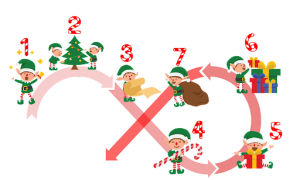
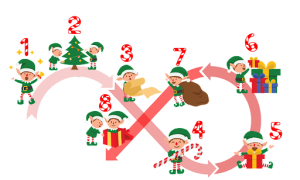
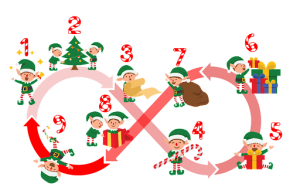
Step 1: Define the Strategic Business Objectives

With the mission defined, but before picking a single area to focus on, Hyper began by wandering through the workshop and learning more about each of the processes and operations being performed by the elves. How could one improve something if you did not know how it worked? He spoke to many elves and even held some elven design thinking sessions to gain a broader understanding the various functions. 

Step 2: Explore the Current Projects and Programs and Identify What May Be Improved

Once Hyper had a good feel for the overall operations, he began to write down the individual tasks and steps, and further document some of the more evident areas that could benefit from some adjustments: wooden horse missing handles and needing to go back through assembly, three elves working on one doll, an iPad Pro without the right color of Space Gray. From this information, he was able to map out what the new processes might look like if they were more efficient or automated. He was even able to run some numbers to see whether efficiencies could be achieved, and how much could be gained through new technologies or general improvements.  

Step 3: Document and Analyze the Current Processes

Now that the top candidates were identified, Hyper could align the low-hanging-fruitcake to the appropriate technology. In this instance, it seemed like such a waste of resources to have their top executive (a.k.a. Santa) have to go through the entire list of hundreds of millions of children to determine their Naughty-Nice Coefficient (N2C). If that were not bad enough, he even did it twice! Hyper knew they had loads of historical data on the children and he knew a lot about the algorithm Santa used to determine their N2C so he was confident that at least some of the decisions could be automated. And after running the numbers, Hyper determined that the workshop could achieve a 500% return on investment if they simply automated a portion of that process to free up some of Santa’s time. It was clear that a business rules management system could help.


Step 4: Align the Appropriate Technology

Before jumping in with both feet, Hyper worked with his counterparts in the technology division as well as some input from the workshop’s CTE (Chief Technical Elf) to build an initial pilot to prove that the new Centrally Automated Naughty-Nice Decision Execution Engine (“CANNDEE”) would provide the benefit they expected. This more incremental approach reduced their risk of investing too much in the wrong area, but would still provide a working tool that Santa could start using right away.


Step 5: Develop an Initial Minimal Viable Product (MVP)

It was a success! Even Santa was surprised by the accuracy of the new CANNDEE application and approval was immediately given to expand the system to a full production deployment. This meant a larger investment, but now that the team had proven that the application could achieve the expected results, the decision to scale up was easy since the benefits would multiply.


Step 6: Deliver a Production Implementation

At this point it was tempting to jump into another implementation; given the huge triumph, there were now many departments at the workshop begging to be next. However, Hyper took a pause and explained that before they start another project, the team should monitor and review the actual results as they came back from the CANNDEE project. 


Step 7: Monitor and Measure the Actual Results

Not only would this provide quantifiable metrics on how successful the project was, but it would also provide insight into how future projects could be prioritized and measured. These measurements would be factored into the refinement of the current approach, and provide input to future considerations and priorities for other potential automation.   


Step 8: Govern and Scale the Program

Hyper believed that only through this disciplined, iterative approach could the workshop achieve scalable success and continuous improvement. This “infinite loop” was seen as a true Christmas miracle by everyone at the North Pole. 


Step 9 (and Beyond): Iterate, Optimize and Repeat

Following the success of the first iteration, Hyper oversaw countless automations going into effect using this new methodology.

The next one that was implemented utilized a content extraction platform to automatically read children’s letters to Santa and categorize them accordingly. The elves codenamed this one “Gimmee”. 

Right behind that was a digital content storage tool so that the letters could be easily searched and archived, and removed the need for the current physical letter storage facilities that were taking up hundreds of square miles of the workshop. 

Soon after a new workflow platform was introduced to help guide the newer elves (a mere 100 years on the job!) through the rigorous process of building the millions of possible toys that were being requested, whereby improving visibility and immediately highlighting bottlenecks and issues. 

Lastly, no stranger to robots, even the elves were surprised when a virtual software robot was created to help with all the manual data entry the poor clerical elves had to do every day. 

“Hyper-Automation” of course!

Now, you may have not heard of Hyper, or even this version of his story, but take note that organizations around the world are taking advantage of this approach and methodology, and achieving significant gains with incremental investments. And what is the name the elves gave to this discipline? Why, “Hyper-Automation” of course! 


Happy Holidays from Salient Process!

Happy Holidays from Salient Process and please visit our previous blogs and videos to learn more about “Digital Business Automation” and how it can immediately help you and your organization! We are all looking forward to a productive and healthy 2022!

Check out our new video about Hyper the Holiday Elf:


Let’s Chat!

START YOUR DIGITAL BUSINESS AUTOMATION JOURNEY TODAY!

Contact VP of Client Services, Jared Michalec to learn more


RELATED CONTENT
More on Digital Business Automation:
More on Salient Process:

Salient Process is a full-service digital business automation shop and proud IBM Automation business partner. To learn more about us at our website, request a free consultation with one of our expert automation advisors! We look forward to guiding you and your company along your own unique Digital Business Automation journey.


STAY CONNECTED

👉Subscribe to Bots & Thoughts: The Digital Business Automation Podcast

👉Subscribe to our Spotify Here

👉Subscribe to our Apple Podcast

👉Subscribe to our Google Podcast Here


⏩Subscribe to Salient’s Monthly Newsletter Here 

🎤Be our next guest! Sign up Here

📲Contact our Podcast Host Here 


  ⏩LinkedIn

👉 Follow Bots & Thoughts on Here

👉 Follow Salient Process Here

👉 Follow our Podcast Host Here

  ⏩Youtube 

  ⏩Twitter 

🌐Learn more at Salient Process

Salient Process Celebrates its 10th Anniversary


Today, Salient Process celebrates its double-digit birthday!

Ten years. A decade. Ten years is a long time, but it also seems like yesterday we opened our doors for business. That is ten years of hard work, focus, and persistence to be where we are today. A decade of building a foundation full of professionally qualified strangers that we now call “family.” A decade of creating valuable foundational partnerships that will serve our partners and customers better. 3,650 days of effective leadership, continual innovation, and transformation.  

Salient’s Story

In 2011, Salient Process was born as a single consultant shop in Sacramento, California. Over the last ten years, we’ve gone from a one-man shop working out of the founder’s pool house to becoming the most well-known and respected provider of services for IBM Business Automation. We are most well-known for developing the SPARK UI, which became IBM BPM UI when IBM purchased it. We are also known for building many value add accelerators such as Automation Compass and the Quick Process Builder for BAW, to name a few. We are an IBM Premiere Business Partner and are a leading Digital Business Automation services and solutions provider. Over the years, we’ve moved beyond our roots in IBM BAW (Workflow) and grown a tremendous reputation for our offerings and services, which include Robotic Process Automation (RPA), Process Discovery, and Decision Management (ODM) 

Thank you to our Employees

Salient Process has grown steadily since 2011. Over the last year, we have doubled in size and have entities in five different countries, with continued growth projected throughout 2022.  Without our dedicated employees committing to high-quality work, values, and the success of our clients, we wouldn’t be where we are today. There is something very heartwarming about working in a fully remote organization, and yet when asked about it, the entire company still proceeds to state that their favorite part about their job is the people and their desire to seek new opportunities within the company. 

Some employee recognition:

Katherine Verhelst, Senior Business Process & Automation Analyst


“My favorite part of working here is that the company cares about the wellbeing of all of their employees, you can grow professionally while you do what you are passionate about, and work in a friendly environment where you can have fun while working.”


Himanshu Jain, Global Services Manager:


“I have worked with multiple companies like Persistent, Tech Mahindra, Infosys, Tata Elxsi. I have chosen Salient Process because of great leaders like Brian and Eric, Good work culture, and the company vision.”

Jimmy Hewitt, Sr. Automation Advisor and Host of Bots & Thoughts: The Digital Business Automation Podcast 


“The reason I chose Salient Process was because of the people! Who wouldn’t want to work with the best? In addition to being surrounded by the best of the best in their field, Salient’s people get it. The environment is purely team-oriented, all hands on deck to accomplish the mission at hand (be the best, delight clients, grow), whether that means stepping a bit outside your daily job requirements, prioritizing each other versus ourselves, and a flat org structure that evaluates all ideas via meritocracy versus tenure. All of this, plus it’s just fun!” 

Thank you to our Leadership

Starting a business and making it successful is a challenging venture. Statistically speaking, only 50% of small businesses survive past five years- so let’s give a round of applause for that success in and of itself. A big part of the companies success has been a stable core of leaders, all of whom have been with the company for the last seven years. This group collaboratively makes all of the key decisions at the company, with as much feedback as possible from employees. Salient’s Leadership team strives to create an environment where people are free to innovate and be rewarded for hard work, regardless of background, race, or creed.


Brian French, CEO and Founder of Salient Process


Salients Ideology

“Our culture is one of leading by example and doing the necessary hard work. Our values all start with the word “we” because we are a ‘we’ company, not a ‘me’ company.” -Brian French, CEO and Founder of Salient Process.

Salients Values:

“We are one, we are transparent; we are passionate about what we do; we have fun; we add value; we practice what we preach; we iterate towards perfection; we reward performance.”-Brian French, CEO and Founder of Salient Process.

A trip down memory lane

As we look back, we would like to thank IBM, our customers, colleagues, friends, family, and those who believe in what we are working so hard to achieve. We appreciate you. 

2010: The idea

Our CEO, Brian French, felt there wasn’t enough focus on process visibility and metrics in the services market. His overall idea was to create a service company to focus on building executable processes and making them visible and measurable. It seems simple in theory, but in practice is very difficult, and that is where Salient differentiates itself.

2011: Salient Process was born

In 2011, within a month of starting Salient Process, Ajay Katre, Salients former Vice President of Delivery, was hired. Ajay and Brian French had met when Brian was still at IBM. While working with Ajay, Brian told himself that if he ever started a company, he would want Ajay to be one of his first hires. Ajay ended up being THE first hire and has been here ever since. Fredrick Nelson was hired about five months later (2012), where he worked in the pool house with Brian before moving into their first real office in 2013.

Ajay Katre, Principal Consultant


Fred Nelson, Lead Business Automation Consultant


2012: Salient becomes a “True Blue” IBM Business Partner

The IBM business partner ecosystem is vast and can be difficult to navigate on your own. Thankfully IBM has done a fantastic job providing Salient Process with the tools and relationships necessary to navigate this ecosystem and become a successful partner. 


2013: The first office

Time to move out of the pool house! As Salient saw continued growth throughout 2012, we were getting too big for the pool house. In 2013, the first Salient Process business office was established in Sacramento, California.

2014-2015: The first of many key hires. 

Jared Michalec is recognized around the world as an expert in the field of Decision Management. In 2014, Michalec was introduced to Salient Process by an IBM colleague and friend, Paul Mackay. Shortly after, Michalec started his new career and is now the Vice President of Client Services. “After alternating my career between very large companies (Andersen Consulting, IBM) and small startup companies (Braun Consulting, AptSoft), at Salient, I appreciate the blend of startup atmosphere with the ability to engage with very large clients. With a large family to support, it was also very important for me to have a strong, fiscally-minded executive team and a flexible work/life schedule.” As the VP of Client Services, Jared ensures that each of his clients achieves real business value from technology and recognizes its true potential. “With the rapid growth in 2021, I am excited for an even more expansive reach and steady increase in our client base and innovation offerings. I believe we are at the brink of something very impactful and rewarding.”

John Stange joined the Salient Family in 2014 as a Project Manager. His position as a sales leader gave him the ability to work in all aspects of the company, from Delivery and Operations to Sales and Marketing. With 15 years of combined Sales and Marketing experience as Vice President of Sales and Marketing, he continues to work parallel with Marketing and Business Development teams to help drive our go-to-market strategy. John firmly believes that efficient and effective processes and strong relationships are the keys to a successful sales and marketing team. Stange looks forward to “Watching Salient continue to become the BEST at what we do.”


Eric Ducos, Salient’s Chief Technical Officer, joined Salient Process in 2015. “I had something valuable Salient was looking for, and Salient had something valuable I was looking for. We were a good cultural fit, and I really liked our CEO’s personality (obviously I caught him on a good day :))” Ducos is the author, designer, and co-implementer of many successful frameworks, products, solutions, technical publications, and certification programs for cross-industry Fortune 500 organizations over the past 20 years. He is a trusted principal and active partner for numerous Advisory Councils, Development Groups, and platform Design Programs related to BPM and ODM for IBM. “I have seen Salient intensely come together toward a common goal and an entire company collectively caring about the outcome. That was very inspiring. My experience feels less like a job and more like a voluntarily shared responsibility across a team made of very different people that are like-minded where it matters.”

2016: Salient’s First Product.

“Our biggest accomplishment was building and selling SPARK UI to IBM in 2016. This still has an impact today as whenever we interview a person for an IBM BAW position at Salient, they almost inevitably state how incredible the work we did there is. It is a huge part of why our reputation today is so excellent. “-Brian French, CEO.

2017: IBM Cloud Award

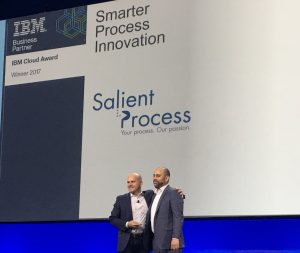
Salient Process was announced as the winner of the IBM 2017 Smarter Process Innovation partner of the year award.  It was very exciting for us to win this award, especially since we were finalists for the Smarter Process award in 2016. It was quite an honor for us to have been in business for only five years and already be on the podium at IBM interconnect, winning an award highlighting our superior solutions for IBM Smarter Process.


2018: Blueworks Insights

Salient Process saw an opportunity to work with clients on expanding their capabilities and usage of IBM Blueworks Live(IBM BWL) by creating custom reports and tools which connect to the Blueworks Live APIs. Blueworks Insights allows users of Blueworks Live to log in and gain new capabilities and insights automatically. Blueworks Live is a powerful process modeling and documentation tool. However, IBM has purposefully kept “guard rails” on the tool in order to maintain the ease of use and simplicity. The idea is not to replace or replicate any feature in IBM Blueworks Live but rather to enhance the user experience and add value to the existing investment.

2019: DBA Sims/ Automation Compass

Furthering Salient’s commitment to adding value and capabilities to the IBM platform, Automation Compass was introduced to assist organizations in the identification of automation opportunities through automated discovery, quantification through simulation and analysis, prioritization through tracking, and management pipeline, and measurement of the outcome of those automations.

2020: Well… we all know what happened here ):


2021: Stay Tuned!

“The work we’re going to be doing to help companies align their process outcomes with corporate goals, and Automation Compass, has incredible potential. I think we’ll look back on this in 10 years and say the work we did here was the foundation of remarkable growth and change for Salient.” – Brian French, CEO.

The last 10 years have been nothing short of incredible.  Most of all, we owe our 10 years of success and growth to our clients who have had continued faith to leverage Salient Process to help guide them through their automation journey.


RELATED CONTENT
More on Digital Business Automation:
More on Salient Process:

Salient Process is a full-service digital business automation shop and proud IBM Automation business partner. To learn more about us at our website, request a free consultation with one of our expert automation advisors! We look forward to guiding you and your company along your own unique Digital Business Automation journey.


STAY CONNECTED

👉Subscribe to Bots & Thoughts: The Digital Business Automation Podcast 

👉Subscribe to our Spotify Here

👉Subscribe to our Apple Podcast

👉Subscribe to our Google Podcast Here


⏩Subscribe to Salient’s Monthly Newsletter Here 

🎤Be our next guest! Sign up Here

📲Contact our Podcast Host Here 


  ⏩LinkedIn

👉 Follow Bots & Thoughts on Here

👉 Follow Salient Process Here

👉 Follow our Podcast Host Here

  ⏩Youtube 

  ⏩Twitter 

🌐Learn more at Salient Process

Are you overpaying for RPA?


Author: Jimmy Hewitt, Sr. Automation Advisor


Living in the ’90s meant many things: we listened to CD players with headphones that never fit quite right, we drove to Blockbuster to rent a movie on family movie night, we were emotionally confused by our Furby – was it cute or creepy? And finally, we prepared for road trips with MapQuest. This blog follows both the GPS evolution story and RPA evolution story and sets out to confront the brutal facts that “first-generation RPA platforms” have been surpassed by newer, more feature-rich, and less expensive RPA platforms, much like the evolution story from first-generation GPS navigation systems to newer, more feature-rich and less expensive (free & fully commoditized) GPS platforms.

Ok, back to the early 2000s. Soon enough, the inevitable happened to MapQuest, and something better came along: the GPS. How revolutionary was the GPS!? My family was severely directionally challenged, so for Father’s Day, we got my dad the family’s very first Garmin GPS (circa 2002?).


I’ll never forget how much we spent on that GPS.

The price of that GPS still haunts me to this day – every time I pull Waze up on my iPhone to get me from point a to point b, I recall the price tag.

The same phenomenon is happening today in the Robotic Process Automation (RPA) space. Yes, Garmin GPS is to Waze as “first-gen RPA” is to IBM RPA.

Allow me to explain.

Buying a Garmin GPS in 2002 meant that we no longer had to worry about getting to our destination. In a sense, this Garmin GPS automated navigation. Similarly, investing in and adopting RPA in 2015 meant that the manual, voluminous, error-prone, and low value but necessary work was now automated. Great, right?!

But what about in 2007 when Apple Maps became available for free on your iPhone? Not to mention how much better the free GPS apps have gotten over time with apps like Waze, powered by massive amounts of data and real-time insights – all for free.

I’ll never forget the day I pulled up a GPS on my iPhone next to my parents and their clunky, expensive Garmin GPS. We felt this palpable sense of “the future.” There was no disappointment or regret associated with how much money they had spent on their Garmin GPS – it was all they could do at the time. Any rational person would have made that same decision given those same circumstances.

The same is true for companies that invested in RPA between 2013 and 2020. It was revolutionary. “Automate anything that humans do on a computer? This is awesome! This is going to save my employees so much time!” This is all true, but this is buying the Garmin GPS.

Technology follows a maturity curve, and RPA has entered the “commoditized” chapter of its life. There are differentiators that set one vendor apart from the other (more on this below), but….

our main argument here is that it’s 2021 and your company might be overpaying for RPA!

We created a simple, self-service health check for you to determine if you might be overpaying for RPA, check it out: Take the 1-minute health check.

Just like the latest generations of GPS apps are getting better, smarter, and faster, with richer features powered by data (socialization, gamification, “cops reported ahead” etc..), the same is happening with RPA. For example, does your RPA base platform come with chatbot services out of the box? Are there cloud hosting options? How about unlimited developer licenses?

IBM RPA is kind of like Waze. It wasn’t the first RPA platform in the market, or even the second or third. Actually, IBM acquired their RPA platform (WDG Automation) in 2020 and has been pouring investments into it, developing and improving upon it since.

IBM RPA is better and cheaper. Not only does the base platform price out approximately 20% cheaper than most RPA vendors, but like the Waze GPS app, it has more features that further maximize the value that your company can get from its RPA platform.

HERE ARE THE KEY DIFFERENTIATORS TO BE AWARE OF IN EVALUATING FUTURE RPA INVESTMENTS:


1. If your RPA vendor charges per user for attended bots…

This is common for RPA vendors, butIBM RPA uses “Floating Licenses” for attended bots meaning that you only pay for how many people are using the system at any point in time – not per user.

The nuance here is “per user” versus “per active user.”

Small nuances can save you a lot of money.


2.If your RPA vendor charges by the developer or development studio…

It is common for your RPA vendor to charge by the developer/development studio, but IBM RPA offers unlimited Studio licenses standard.

This means that you don’t have to pay for each developer accessing your RPA development studio and can democratize RPA across your organization without worrying about rampant license fees.


3. If your RPA vendor requires a different VM for each bot…

Vendors requiring a different VM per bot is common for RPA vendors, but IBM RPA uniquely allows multiple bots to run on the same VM.

This saves you money on supporting infrastructure as well as the operational cost of maintaining the supporting servers.

4. If your RPA vendor does not offer native chatbot services…

Most don’t, butIBM RPA does.

Standard with the base platform IBM RPA entitles you to your own AI-powered chatbots! Configure one of these in minutes, and you’ll be able to tell your co-workers that you just developed a real AI bot.


5. If you began your RPA journey before 2020…

Similar to the circa 2002 GPS system for your car, early RPA adopters are paying more than newly minted RPA customers. If it’s been a few years since you originally invested in RPA, it may be a good idea to have an in-depth comparison to IBM RPA’s licensing model.

Even better is thatSalient Process can automatically migrate your RPA projects for you with our proprietary Botverter.

6. Other unique features and functions for IBM RPA…

Fuzzy Logic:A prevalent RPA scenario involves generating a report, copying, and pasting a specific piece of data into another report or system. What if the location of that specific piece of data changes from one report (cell G3) to the next (cell H3)? Your RPA bot should be smart enough to pick up on this as a human would.

No code development: Most RPA platforms require heavy IT involvement. While this will always be the case for things like security, infrastructure management, and system integration, why not find an RPA platform that requires minimal IT involvement in developing a bot? IBM RPA has a “record” feature that allows even the most technologically novice users to build their own RPA bot. Just click record!

Developer collaboration via scripts: Developer collaboration within your IBM RPA Studio environment allows the developers to interact with the bots as a script which means faster collaboration via slack or other tools. Imagine sharing a script via slack/teams, pasting it into your bot, and it just works! No tedious publishing and repository actions are needed.

Native integration to Digital Business Automation: Digital Business Automation has been Gartner’s Top Strategic Trend for the last two years running. It refers to the combination of multiple, distinct digital business automation capabilities. RPA is great, but combining RPA with BPM, iOCR, and Business Rules Management allows 1+1+1 = 10!


Let’s Chat!

START YOUR Digital Business Automation JOURNEY TODAY!

CONTACT SR. AUTOMATION ADVISOR, JIMMY HEWITT TO LEARN MORE


RELATED CONTENT
MORE ON Digital Business Automation:
MORE ON SALIENT PROCESS:

Salient Process is a full-service digital business automation shop and proud IBM Automation business partner. To learn more about us at our website, request a free consultation with one of our expert automation advisors! We look forward to guiding you and your company along your own unique Digital Business Automation journey.


STAY CONNECTED

👉Subscribe to Bots & Thoughts: The Digital Business Automation Podcast

👉Subscribe to our Spotify Here

👉Subscribe to our Apple Podcast

👉Subscribe to our Google Podcast Here


⏩Subscribe to Salient’s Monthly Newsletter Here 

🎤Be our next guest! Sign up Here

📲Contact our Podcast Host Here 


  ⏩LinkedIn

👉 Follow Bots & Thoughts on Here

👉 Follow Salient Process Here

👉 Follow our Podcast Host Here

  ⏩Youtube 

  ⏩Twitter 

🌐Learn more at Salient Process


7 Steps of Process Improvement


Author: Geoffrey Hamm, Sr. Automation Advisor


It starts with a map. 

In 1983, Clark Griswold (all-American dad and fictional character) loaded up his family in a tragically unhip station wagon, heading west. 

Destination: Wally World, “America’s Favorite Family Fun Park.” 

Using the advanced computer simulations of the day, Clark was able to plot an optimized course – getting the maximum amount of fun time at Wally World without missing any of the “good stuff along the way.” 


For those unfamiliar few who haven’t seen National Lampoon’s Vacation, their trip was… ill-fated. Riddled with setbacks but, eventually, they made it. In fact, given the comically high volume of setbacks, it is probably fair to say the only reason they made it was due to Clark’s preparedness and tenacity. Even in the face of extreme adversity, leaning into tried-and-true processes can minimize bad outcomes (i.e., future-proofing). 

When tasked with process improvement and digital transformation, it’s easy to feel overburdened.

How do we plan for something like that?

What are the right steps (and in what order)?

Are we focusing on the right things?

How do we avoid setbacks?


… It’s normal to feel overburdened.


Salient Process can help alleviate that burden.  

We know the steps to help you build a successful process improvement and digital transformation practice. As a process company (literally, in the name), we have a process for process improvement – a process improvement process, if you will. 

If you follow these steps, take it one mile at a time, keeping your eyes on the road – not on Christie Brinkley in the Ferrari 308 GTS (another Vacation reference) – we can help you get to where you need to be.  

Here are the 7 steps of process improvement:
  1. Choose your destination 
  2. Map your processes 
  3. Identify and quantify opportunities 
  4. Prioritize your opportunity pipeline 
  5. Improve process and/or implement automation 
  6. Continue to measure the improved process 
  7. Repeat 


1. Choose your destination

It all starts with a map; however, a map without a destination is fairly useless.  

American politician Henry Kissinger once said, “if you do not know where you are going, every road will get you nowhere.” 

Choosing a destination within digital transformation can be a real challenge. We’d all like to be better, faster, smarter, but… Better how? How much faster? Smarter in what way? 

Over the years (and hundreds of successful projects later), Salient Process has refined a North Star exercise to help our clients identify that destination much quicker and with greater confidence. 

The outcome of this exercise is a destination, and a means to determine that we have successfully arrived there. If I follow a map to the Grand Canyon and don’t see a massive hole in the ground when I get there, it might be time for a new map. The North Star exercise gives us a destination and establishes our unique success criteria (The Grand Canyon of metrics). 

Our CEO Brian French wrote a great article on this North Star exercise.  

2. Map your processes

Now that we know where we want to be and what it should look like when we get there, we can plot our course. We can now begin mapping our processes.

In this phase, it is important to focus on the way things actually work, not the way we wish they worked (we’ll get to that later). We often refer to this as “current state” mapping aka your “As-Is”. In the first step, we determined where we’re going; now, we’re determining where we’re starting from (equally important).

Have you ever looked at a mall directory that didn’t have a “You Are Here” symbol? Fairly useless.

Sometimes this step can feel like we’re just drawing pretty process pictures, but it’s much more than that: we’re collecting data (data which will be used in later steps).

Using IBM Blueworks Live, we can map processes with ease. So much ease, in fact, that we can offer team members with absolutely no process experience a seat at the table. That being said, if you or your team members don’t have the time to commit to this pursuit, Salient can provide analysts to operate as an extension of your team

  • Interviewing your subject matter experts
  • Discovering your processes
  • and Mapping them inside yourBlueworks Live environment.
  • it’s that easy!
3. Identifying and quantifying opportunities

As mentioned previously, the biggest output of the process mapping exercise is data.

“‘Data is the new oil’ – Clive Humby” – Mark Cuban

The unabridged version of this quote originally by Clive Humby, since echoed by many, is as follows:

“Data is the new oil. It’s valuable, but if unrefined, it cannot really be used. It has to be changed into gas, plastic, chemicals, etc… to create a valuable entity that drives profitable activity; so must data be broken down, analyzed for it to have value.”

The data gathered in the previous step is only worth as much as our ability to consume it. If you buy a Ferrari and don’t drive it, why did you even buy it? You should drive it… and you should let me drive it too.

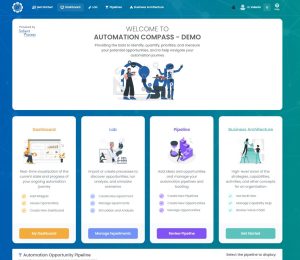
Automation Compass by Salient Process lets you “drive” your processes.

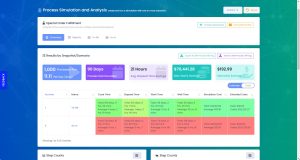
Automation Compass ingests your Blueworks Live maps, allowing you to run simulations against them – identifying gaps, bottlenecks, and waste.

From here, we can begin “future state” mapping aka your “To-Be”.


We can make changes to our current state maps and rerun the simulations to assess the impact of the proposed changes:

  • What if a certain task was fully automated?
  • What if it was partially automated?
  • What if we hired another team member?
  • What if we reduced the likelihood of going down certain exception paths?

All of these questions (and many more) can be answered using Automation Compass. 

»Start your Automation Compass Journey Today!

We’ve come a long way since the “Trip Tic.”

And, if you desire a more hands-off approach, Automation Compass can programmatically identify opportunities on your behalf. Using a proprietary algorithm powered by IBM Watson, Automation Compass can automatically uncover potential areas of business automation and show us how they align to specific capabilities.


All opportunities we identify (or that are identified for us) can then be added to an opportunity pipeline within Automation Compass, allowing us to build and manage a backlog of improvement areas.


4. Prioritize your opportunity pipeline

Commenting on the incessant inquiries into his writing process, Stephen King once said, “I invariably answer ‘one word at a time.” 

At this juncture, we presumably have a list of process improvement opportunities. We have to choose which opportunity to tackle first.

Sometimes this decision is made based on less quantitative criteria (i.e., focus on a certain business unit or higher-level strategic initiatives), but most often, it comes down to the business case and the anticipated return on the investment (ROI). Coming out of the last step, we should have a pretty good idea of how much time and/or money the proposed changes might save us. With that information in hand (as well as a working estimate of the implementation cost), calculating the ROI is rudimentary.

The icing on the cake – you can do this from Automation Compass as well.

With a business case in hand and a compelling ROI to back it up, it’s time to rig the spark cables to Frankenstein’s neck (a.k.a. bring it to life)!


5. Improve process or implement automation

To stay consistent with my quote drops from previous sections, here’s another one:

“Just do it” – Nike 

Now that we have chosen a worthwhile project, it’s time to implement it. Projects come in all shapes and sizes. The mission should be clear by this point, especially if you’ve been working with us and have adhered to the steps. The project may or may not involve one of our Automation offerings. Automation obviously lends itself to process improvement, but process improvement can happen in various other ways (no longer requiring TPS reports, for example).

However, if it does involve automation, partnering with Salient and leaning into our experts and their expertise is a sure-fire way to get it across the finish line and swiftly into Production.

Remember, “getting there is half the fun.”

6. Continue to measure the improved process

Now we’ve improved our process. Look how far we’ve come since the Chevy Chase cold open? Wow! It may seem like the title credits should roll now, but we’re not quite there yet.

Peter Drucker, perhaps the most influential voice in modern management, once said, “you can’t manage what you don’t measure.” This is a quote I often pull a Tommy Boy while trying to recite. Bless the written word.

Measuring ongoing success seems obvious, but many people don’t do it. Once one project concludes and another begins, it’s human nature to have an “on to the next” mentality. It is great to be forward-looking, but we also want to make sure our previous efforts were successful (and continue to be).

The opportunity pipeline in Automation Compass can also be used to track ongoing metrics, like how much the process has saved you since its inception.

Never stop improving, but also never stop measuring. Take the time to celebrate your successes (or learn from the setbacks).


»Start your Automation Compass Journey Today!

7. Repeat

Brian McKnight once said (sang rather), “if ever I believe my work is done, then I start back at one.”

For the same reason, the Griswolds couldn’t just go to Wally World. We can’t just stop improving our processes after a single project. We’ve got to go to Europe, Las Vegas, Christmas with the in-laws, Christmas on an island, and as many other places as we possibly can while the franchise is still doing well at the box office.

Process improvement never ends. If you aren’t always looking for ways to improve more things, your competition surely is. Don’t think of it as a Sisyphean task; think of it as building a good habit – like exercising. You don’t want your competition to have bigger biceps than you.

If you go to the gym and do 45 minutes of cardio each day, that’s great! If you go to the gym and do 45 minutes of cardio each year… fairly useless. 

On the other hand, if you stick to the plan and develop those habits, you will see results. As Brian McKnight also said, “it’s undeniable.”

Following these steps, we can:

  • Increase the number of items being purchased globally by 2000%
  • Remove 70% of manual and redundant steps
  • Increase our audit output by 300%
  • Reduce processing times by five weeks on average
  • Provide 80% improvement in cycle times
  • Increase user base 100x
  • Decrease our test request processing time by 80%
  • Increase customer engagement by 80%
  • Decrease reliance on IT by 200%
  • Increase customer conversion rate 5x
  • Cut our development time by 50%
  • Find $50 million per year in savings
  • Process over 5 million events and rules per day
  • Send 50,000 qualified, relevant and targeted emails per day, etc.

These are all metrics from actual projects.

Following these steps, we can do remarkable things. It all starts with a map.


Let’s Chat!

START YOUR Digital Business Automation JOURNEY TODAY

CONTACT SR. AUTOMATION ADVISOR, GEOFFREY HAMM HERE TO learn more


MORE ON Digital Business Automation:
MORE ON SALIENT PROCESS:

Salient Process is a full-service digital business automation shop and proud IBM Automation business partner. To learn more about us at our website, request a free consultation with one of our expert automation advisors! We look forward to guiding you and your company along your own unique Digital Business Automation journey.


STAY CONNECTED

👉Subscribe to Bots & Thoughts: The Digital Business Automation Podcast

👉Subscribe to our Spotify Here

👉Subscribe to our Apple Podcast

👉Subscribe to our Google Podcast Here


⏩Subscribe to Salient’s Monthly Newsletter Here 

🎤Be our next guest! Sign up Here

📲Contact our Podcast Host Here 


  ⏩LinkedIn

👉 Follow Bots & Thoughts on Here

👉 Follow Salient Process Here

👉 Follow our Podcast Host Here

  ⏩Youtube 

  ⏩Twitter 

🌐Learn more at Salient Process

Debunking 6 A.I and Digital Business Automation Myths


Author: Jimmy Hewitt, Sr Automation Advisor 


Geoffrey Chaucer, in Canterbury Tales, tells us that “time and tide wait for no man.” Adam Smith and his invisible hand take it a step further by implying that the same is true for business opportunities. If an opportunity exists to gain a competitive advantage in the market, then it will be taken.   

It’s just a matter of who will take it and who will wish that they did.  However, even though Artificial Intelligence (A.I.) and Business Automation are some of the most successful, paradigm-shifting advances in business solutions, there is an understandable number of risks in and around investing and implementing.   

That’s why we, at Salient Process, decided to leverage our experience and learnings from over 600 successful client engagements to shine a light on some of these dark myths of implementing A.I. and Digital Business Automation solutions for your business.  Here is 6 Digital Business Automation Myths- De-Bunked!


1. A.I. & Software robots will take my job!

False!

Rather than taking your job, it will remove the least enjoyable and most manual/mundane part of your job while freeing you up for more knowledge-based and value-add activities. Not a bad deal, right? For example, on the more basic end of the A.I. and Automation spectrum, we have Robotic Process Automation.  One single bot can give back thousands of hours to a corporate finance team by automatically generating reports to compare a daily forecast to yesterday’s actuals.  Rather than the FP&A team losing their job to A.I., they’ve outsourced the most boring part of it to technology!


2. A.I. will cure cancer!

You guessed it, False! 

Curing cancer is quite possibly the loftiest and complex goal ever set for artificial intelligence, and at best, the jury is still out. That said, A.I. and Digital Business Automation are making positive impacts on healthcare and the 20% of our GDP ($3.6 trillion) that we spend on it.  For example, according to the National Library of Medicine, over 30% of the $3.6 trillion that providers and payers spend annually is earmarked towards “administrative expenses,” which, in other words, means “the management of paper-based forms and the data within them.”  A.I. and Digital Business Automation can absolutely make a dent in this problem (ex: digitized medical encounter records). We’re still optimistically holding our breath on curing cancer, though. 


3. A.I. is just fancy number crunching.

False!

Algorithms did receive the majority of the A.I. spotlight in its early days and still, have a major impact on business today (i.e., algorithmic trading in Finance, route & fuel optimization strategy for Trucking and Transportation, etc.), but we’d like to shine the spotlight on a new way of looking at A.I. and Digital Business Automation. If we decompose A.I. into its core meaning, we can equate it to a software program/platform that performs tasks much like a human would perform those tasks. You have A.I. if you invest in a solution that can replicate human tasks (but faster, better, cheaper, etc.).  There is a whole world of undiscovered A.I. in the form of Digital Business Automation – a technological trend that Gartner is calling a top 10 strategic trend for 2021. Learn more about this topic here on our YouTube channel.


4. Efficiency is the goal for A.I. and Digital Business Automation.

False!

Focusing purely on efficiency just means minimizing waste.  While this is generally good for business, it does not ensure an optimal outcome. As opposed to efficiency, efficacy is the goal for Digital Business Automation it is defined as “the ability to produce a desired or intended result.”  Talk about a nuance – but this nuance matters! By focusing on business results, as opposed to eliminating waste, our automation clients achieve just that.

5. A.I. Implementations are expensive.

False again! 

Admittedly, there are plenty of articles and research out there saying that a sizable percentage of A.I. projects fail to deliver on the originally intended business value, but that has not been our experience or that of our clients. With a disciplined approach (we use our own North Star Methodology combined with our proprietary Automation Compass), an expert-level partner, and realistic expectations, we have seen a payback period for A.I. & RPA investments as short as months, and in some cases, days! Adam Smith and I would actually argue that the expensive part is the lost productivity accrued from not implementing A.I. & Digital Business Automation.

6. A.I. is not for my business.

False!

We have implemented successful A.I. and Digital Business Automation projects with companies ranging from one-person startups to the Global 100. We can work with you to ensure that we are not just automating for automation’s sake; rather, we quantify the investment and calculate the benefits to ensure the project aligns with your unique business objectives.


Let’s Chat!

START YOUR Digital Business Automation JOURNEY TODAY!

CONTACT SR. AUTOMATION ADVISOR, JIMMY HEWITT TO LEARN MORE


RELATED CONTENT
MORE ON Digital Business Automation:
MORE ON SALIENT PROCESS:

Salient Process is a full-service digital business automation shop and proud IBM Automation business partner. To learn more about us at our website, request a free consultation with one of our expert automation advisors! We look forward to guiding you and your company along your own unique Digital Business Automation journey.


STAY CONNECTED

👉Subscribe to Bots & Thoughts: The Digital Business Automation Podcast

👉Subscribe to our Spotify Here

👉Subscribe to our Apple Podcast

👉Subscribe to our Google Podcast Here


⏩Subscribe to Salient’s Monthly Newsletter Here 

🎤Be our next guest! Sign up Here

📲Contact our Podcast Host Here 


  ⏩LinkedIn

👉 Follow Bots & Thoughts on Here

👉 Follow Salient Process Here

👉 Follow our Podcast Host Here

  ⏩Youtube 

  ⏩Twitter 

🌐Learn more at Salient Process

Numbers only tell half of the story


Author: Jimmy Hewitt, Sr. Automation Advisor


Work

We all do it – and a lot of it.

Most of us go to work, do our job, and repeat. We are so focused on our job that imagining an easier way to do it only happens in our dreams. What we may or may not be acutely aware of as workers is that 20-40% of our job includes manual and low value tasks. Think about it, even highly paid CPAs are spending their days pulling reports and massaging data – what a waste of productivity! Facts and figures only tell half of the story – the other half is up to you, how they are interpreted and apply to you. I hope you enjoy the numbers within this blog but more importantly, if it applies, that meaningful change is acted upon and realized within your daily work life and that of your organization.

But why is this important?

What trends have emerged in the workplace, and what impact do these trends have on our customer experience, employee experience, and strategically on the organization’s ability to navigate the next several years?

The IDC tells us that 30% of customers are forecasted to leave a brand and never return due to an awful experience. Contributors to this include manual process management, manual data entry and manual decision making. If your middle-back-office processes are manual, this statistic may apply.


Customers are important but so are we! 74% of HR professionals are concerned over workplace digital divides, according to CompTIA. A distributed workforce means a distributed workflow – managing a distributed process across states and time zones via email and meetings contributes to the digital divide, and the lengthy customer wait times.

Finally, strategically speaking, 50% of CEOs, according to Your Story, feel that their organizations lack innovative processes that enable adoption and swift response to disruptive circumstances. This means that not only is process excellence important to our customers and employees, but a lack of process excellence leads to organizational rigidity and stifles innovation.

These three startling statistics underscore the negative impact our customers, employees and organizations are dealing with in a pre-automated business environment. Thankfully, hyperautomation is here – and is very real.

Let’s look at the positive impact that hyperautomation is driving today.

What is the rationale?

Customers don’t want to wait on us, employees don’t want to be in gridlock, and our organization does not want to be rigid.

So where are managers and organizational leaders starting their digital automation journeys, and why?

For starters, 90% of COOs who are scaling digital automation are doing it to create higher value work for their existing employees, according to an IBM Institute for Business Value (IBV) study. You have likely heard this a lot, but it makes sense. By automating some portion of the manual, copy and paste, and spaghetti-processes that are not properly managed today, IT Wire has reported that organizations can 10x the speed and accuracy of work. Specifically, if you are on a corporate finance, operational (like supply chain or sales ops), HR or a Procurement team and have undergone an automation project, then you and your colleagues will be left only with higher value work to do! This is 90% of every COO’s dream.

Part and parcel to 10x-ing the speed and accuracy of certain manual tasks and isolating higher value work for your employees is productivity. That is why according to Analytics Insight, 34% of organizations are adopting hyperautomation (for employee productivity reasons). Productivity reduces operational costs – specifically, Gartner estimates a categorical 30% reduction here by 2024 through hyperautomation. It is no surprise that hyperautomation drives improvements in categories such as speed, accuracy, value of work, and operational cost, all of which drives customer satisfaction, which according to Analytics Insight is 21% of respondent’s rationale for adopting hyperautomation. Regardless of the rationale, adopters are experiencing a host of value form digital automation.

Has it been done before?

Digital Automation is not new, and if organizations have not begun their journey, they’re falling behind.

McKinsey has reported that 2.6 trillion hours of work are being automated per year in the US alone and the Wall Street Journal has reported a whopping 37,000 US-based AI job postings, which is up 45% from the previous year. This uptick in AI jobs will deliver $134 billion in labor value in 2022, per an IBM IBV study.

The transition of manual and low-value work from knowledge workers over to digital automation is not only paramount but also very real. The World Economic Forum has reported that the division of labor has transitioned from 71%/29% human/machine in 2018 to 58%/48% by 2022. Reflected in job openings, labor value and the opinions of globally respected consulting firms, hyperautomation is not new and if organizations haven’t begun to adopt it, they’re falling behind.

So, what is stopping you?

31.9% of respondents say that the largest barrier to adoption is a lack of skill. This makes sense and is why organizations like IBM and Salient Process are here. Together we partner with our clients to help them overcome the skills barrier and adoption curve. In summary, I’d like to say something like “manually kicking the can is no longer an option” but that would be leading the witness. I hope you enjoy the numbers within this blog but more importantly, if it applies, that meaningful change is acted upon and realized within your daily work life and that of your organization.


LETS TALK ABOUT IT!

Start your Hyperautomation Journey Today!

Contact Sr. Automation Advisor, Jimmy Hewitt to learn more


RELATED CONTENT

MORE ON HYPERAUTOMATION:
MORE ON SALIENT PROCESS:

Salient Process is a full-service digital business automation shop and proud IBM Automation business partner. To learn more about us at our website, request a free consultation with one of our expert automation advisors! We look forward to guiding you and your company along your own unique Hyperautomation journey.

 

STAY CONNECTED

👉Subscribe to Bots & Thoughts: The Hyperautomation Podcast 

👉Subscribe to our Spotify 

👉Subscribe to our Apple Podcast

👉Subscribe to our Google Podcast


⏩Subscribe to Salient’s Monthly Newsletter Here 

🎤Be our next guest! Sign up Here

📲Contact our Podcast Host Here 


  ⏩LinkedIn

👉 Follow Bots & Thoughts on Here

👉 Follow Salient Process Here

👉 Follow our Podcast Host Here

  ⏩Youtube 

  ⏩Twitter 

🌐Learn more at Salient Process

The Process Rush: An Introduction to IBM Process Mining


Author: Geoffrey Hamm, Sr. Automation Advisor


Over the years, our perception of the word “mining” has changed a lot. Whereas 20 years ago, it most likely brought about imagery of bearded prospectors in overalls trying to get rich quick (think Gus Chiggins), nowadays it may be more associated with young Crypto-conscious investors… also trying to get rich quick. “Process Mining” reinforces the application of the word as it relates to intangible assets (less gold and coal, more Bitcoin and now… process).

In 2021, IBM announced the acquisition of myInvenio, an Italian Process Mining company. This has left a lot of people asking….


“Process Mining? What is that?”

Process Mining is an emerging technological approach to process discovery and improvement that tells us how our processes really work – often in stark contrast to how we think they work. Today I want to give you a quick introduction to IBM Process Mining, then discuss how it works and how it can help you.

As previously mentioned, IBM Process Mining began as an Italian start-up called myInvenio – adding Process Mining to the long list of things Italians got right, alongside food and fashion.

The tool was originally marketed as a disruptive solution that automatically analyzed and monitored business processes and predicted future trends. Now, paired with IBM’s canon of pre-integrated technologies, the vision has expanded.

Per IBM’s acquisition statement:

“myInvenio capabilities reveal inefficiencies, bottlenecks and tasks that can benefit from automation, to help organizations significantly reduce their operating costs and improve customer service. Simulations can be run to assess automation opportunities to measure the benefits of applying automation at the outset of the automation journey. By analyzing historical process execution data and desktop behavior, myInvenio technology can help determine where to apply RPA bots, automated decisions, AI models, and other automations to have the most impact on a business.”

IBM Cloud Automation GM Dinesh Nirmal seconded that sentiment:

“With myInvenio, IBM can help customers identify the business processes that may benefit most from automation. When myInvenio capabilities are added to existing workflow, decisions, RPA, content and capture capabilities, we’ll be able to offer customers a one-stop shop for implementing enterprise-wide intelligent automation to support digital labor, augmented workforces and automated operations. With myInvenio, I anticipate that we’ll be the first vendor to offer such a complete and integrated set of end-to-end AI-powered automation capabilities to customers. The capabilities will be part of the IBM Cloud Paks for Automation and powered by Red Hat Open Shift to run anywhere — helping customers automate their entire enterprise.”

As explicitly called out by Dinesh, Process Mining is on target to become the next big tool in the Digital Business Automation toolbox. If “Digital Business Automation” is a foreign term to you, check out this blog written by our CEO Brian French. We also recently hosted a webinar on the same topic (replay can be found here).

Based on the nature of the tech, and confirmed by these statements from IBM, it’s clear that Process Mining will play a pivotal role in the assessment and application of core Automation technologies going forward. But how exactly does it work?

How It Works?

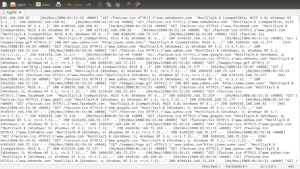
Fundamentally, Process Mining analyzes business processes from event logs. If you take a second to think about it, we all interact with a multitude of systems throughout the day as we conduct our work (i.e. CRMs, ERPs, Email, etc…). Most of these systems have log files where events are recorded. They might look a little something like this:


Some nice light reading, huh? NOT! These are NOT the kinds of files you want to spend your day looking through.

That being said, logs often contain valuable, untapped data… and lots of it.

IBM Process Mining consumes these log files and turns them into something we, as humans, can actually use:

You may be wondering – what is the relationship between Process Mining and Process Modeling?
Good question.

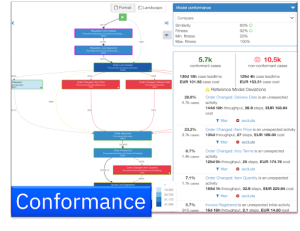
The output of Process Modeling (BPMN) can be consumed by IBM Process Mining. When consumed, we can use IBM Process Mining to tell us about our models’ conformance. To put it simply, Process Mining will tell us if our processes are actually doing what it is we think they are doing.

For IBM Process Mining to tell us that however, we must first disclose what it is we think our processes are doing (it’s Artificial Intelligence, not Artificial Mind Reading). Thus the need to consume those BPMN files. This in turn becomes our “reference model”.

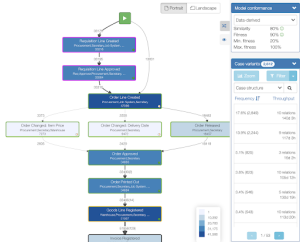
Here’s a look at what the tool will generate given some log files and a reference model:

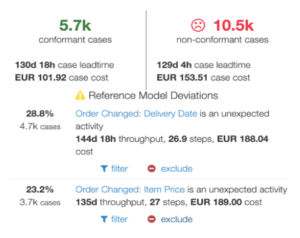
As you can see, the tool will identify conformant and non-conformant cases. In this example, what the process did and what we expected it to do were very misaligned: nearly twice as many non-conformant cases as conformant ones, and with a handful of activities we were not anticipating.

How Can It Help You?

Well, first of all, it can tell you if your processes are running as expected. It can also tell you how often certain activities are happening, how long they’re taking, and how much they’re costing you:

In addition to consuming process models for reference, IBM Process Mining can also generate process models for reference elsewhere. Thus, it can be used in lieu of process modeling in certain circumstances – or as a launchpad for process modeling in others.

The output from IBM Process Mining can be used by Salient’s Automation Compass to take it the next level – automatically identifying automation opportunities, running simulations against different versions of the process, and even calculating ROI.

My colleague Jared Michalec wrote a great article on how Automation Compass (called DBA Sim at the time of publishing) can be used to identify and prioritize automation opportunities based on data which IBM Process Mining provides (i.e. process models, volumes, activity times, work schedules, decision outcomes, etc…)

At this point, it probably seems fairly obvious how Process Mining will play a critical role in the upfront efforts of budding Automation initiatives, but I think it will also be paramount in ongoing efforts – “checking our work”.

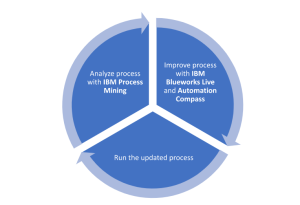
We can create a continuous improvement loop in which we analyze the effectiveness of our process using IBM Process Mining, improve the process using IBM Blueworks Live and Automation Compass, let the improved process run, then analyze the effectiveness of our improved process using IBM Process Mining.

Here’s a chart I made for the people who don’t like to read as much:

Figure 1: Continuous Improvement Loop


In the late 1840’s, rumors spread of gold in California. Almost instantaneously, the mining began. Some people struck gold, and some people struck out. Now, nearly 200 years later in the early 2020’s, the “gold” is locked inside our data. The mining has started. Undoubtedly, some organizations will strike out…

Luckily, Salient Process is uniquely positioned to help you strike [process].

So, if Process Mining is of interest to you and your organization, let’s chat!


Let’s Chat!

START YOUR Digital Business Automation JOURNEY TODAY

CONTACT SR. AUTOMATION ADVISOR, GEOFFREY HAMM HERE TO learn more


MORE ON Digital Business Automation:
MORE ON SALIENT PROCESS:

Salient Process is a full-service digital business automation shop and proud IBM Automation business partner. To learn more about us at our website, request a free consultation with one of our expert automation advisors! We look forward to guiding you and your company along your own unique Digital Business Automation journey.


STAY CONNECTED

👉Subscribe to Bots & Thoughts: The Digital Business Automation Podcast

👉Subscribe to our Spotify Here

👉Subscribe to our Apple Podcast

👉Subscribe to our Google Podcast Here


⏩Subscribe to Salient’s Monthly Newsletter Here 

🎤Be our next guest! Sign up Here

📲Contact our Podcast Host Here 


  ⏩LinkedIn

👉 Follow Bots & Thoughts on Here

👉 Follow Salient Process Here

👉 Follow our Podcast Host Here

  ⏩Youtube 

  ⏩Twitter 

🌐Learn more at Salient Process


Digital Business Automation for Business Leaders: Pick Three – Happy Employees, Loyal Customers, or Bigger Profits


Author: Jimmy Hewitt, Sr. Automation Advisor


“Time flies like an arrow; fruit flies like a banana”

–Anthony  G. Oettinger, Futurist,  Linguist & Computer Scientist

Time is our most precious resource, and college does a respectable job of teaching us this lesson. Allow me to illustrate with an image that you have likely seen before: 

“The College Tradeoff”

College was then, business is now. And in business, the three biggest worries are our employees, customers, and profitsIn a perfect world, every employee is working to support these three worries, but the reality is that the buck stops with managers, directors, and executives. The best leaders are servant leaders, and we exist as stewards of our employees, customers, and profits. 

Now, unlike the college first-year student stuck with a choice of two, the savvy business leader can have all three. That is right. You can have all three. 

Having consulted for the better part of the past decade for mom n pop shops all the way up to multiple Fortune 10 clients, no other technology investment I’ve seen can alleviate your business worries like Digital Business Automation does.

Digital Business Automation lets you pick three: Happy Employees, Loyal Customersand Bigger Profits. Here is how. 

Let’s start with employees.

“If I had 6 hours to chop down a tree, I would spend the first  four  hours sharpening the axe.” – Abraham Lincoln 

The Society for Human Resource Management (SHRM) had a field day during the pandemic as they collected and analyzed the latest employee/workforce data. 

Here is some of the most disturbing data collected, that should send any business leader straight back to the drawing board: 

“Employees are working longer, spending more time in meetings, and having to keep up with more communication  channels. 

Nearly 70% of professionals new to remote work now work on the weekends 

“45% of professionals work more hours during the week then they did before the pandemic”

At this time, we introduce Digital Business Automation into the conversation. If you are not up to speed on Digital Business Automation and would like to be, go here. 

I don’t have enough time” – your employee, probably. 

Which is worse? An employee who says that they do not have enough time, or an employee who does not speak up about it?  

Here are some examples of IBM’s Digital Business Automation platform giving time directly to employees: 

  • PNC Bank: 80% reduction in loan applications requiring manual review 
  • Banco Popular90% decrease in process completion time 
  • Turkcellreduce approval time from days to minutes  

Ok, great – Digital Business Automation can improve the employee experience, but that’s only one out of three! What about my customers and profits?” 

In the next two sections, you will see how the same platform, IBM’s Cloud Pak for Business Automation (and in many cases, the same exact solution), can support not only your employees, but also your customers and profits. 

Customers 

Customers (surprisingly) only have a finite amount of time and attention to give you and your business, so the more time we can give our customers and prospective customers, the more likely they are to do and repeat business with you. Here is an example from the banking industry – I encourage you and your imagination to draw a parallel to your own industry and business. 

PNC Bank implemented hyperautomation and as a result, gave time back to their loan application process employees (analysts, managers, loan originators, underwriters etc..). But this is the “Customers” section, so how does this translate to their customers? 

Basically, loan applicants (customers) primarily act on two factors – interest rates and speed. Every industry has their own factors that customers act on, tell me yours in the comments below! For banking, rates need to be competitive. Assuming that they are competitiveloan applicants will generally bank with whomever gets back to them fastest (interest rates and speed). Make sense? 

By giving back 80% of the loan application and origination process to PNC’s employees, they simultaneously improve their customer response time and therefore their customer closing rates. 

Let us run this again, but through a different industry… 

In a completely different but equally competitive industry, Retaila quick example of Hyperautomation helping employees and customers can be found in the call centerHumming and buzzing with phone calls, chatter, or maybe from the agent’s home office (it is 2021), call centers can be considered one of the many front doors of your business.  

How many call center agents do you keep? How many extras are hired during the holiday season? What is the call center’s Net Promoter Score (NPS)? What is your average handling time? What if Digital Business Automation could cut that in half and double your NPS? 

The Retail call center example is a common one for a reason  agents spend a lot of time manually pulling up customer profiles (it doesn’t have the be that way), manually updating customer information – in multiple systems (it doesn’t have to be that way), not to mention the fact that they are too busy doing this to actually listen – much less to get proactive and offer value-add crosssells and upsells (for example, a customer calls to check on a sweater order, agent rapidly provides the status update, and offers a “while I’ve got you, would you like to add a matching pair of knit mittens on 50% off today to that order?). 

Digital Business Automation helps employees and customers at the exact same time. The next and closing section illustrates how it all comes together by adding the third part into the mix: Profit. 

Profit 

Profit isn’t a purpose, it’s a result” – Jack Welsh, probably

Before making a claim like “Digital Business Automation will increase your profits” I’d like to offer a qualificationdepending on the size of your company, there are virtually endless sources of profits and losses within a company

Investing in Digital Business Automation can and will increase your profits, but only if implemented alongside experienced professionals*(*At Salient Process, we use the IBM Cloud Pak for Business Automation (platform) combined with a modified Gartner Infinite Loop approach (method) to our client Digital Business Automation projects and programs, complete with a CoE (Center of Excellence) for ensuring ongoing success and growth). 

 Now that the qualification is over, let me bring home the third and final category of corporate benefits associated with Digital Business Automation: Profits. 

A recently commissioned Forrester Total Economic Impact study quantified the three-year financial impact for a recent Digital Business Automation customer of IBM Cloud Pak for Business Automation. Here were the results of the investment in Digital Business Automation: 

  • 675% Return on Investment (ROI) 
  • $20.8 million in Net Present Value (NPV) 
  • <6-month payback 

Digital Business Automation projects and programs by nature drive short- and long-term profitability! Quick win profits come from giving time back to your employees, while longterm, sustained profitable growth comes from reinvesting this newly saved time into higherorder activities. For example, higherorder activities vary based on industry, but include passing the time savings onto your customers with shorter wait times, faster responses to inquiriesfaster decisions being made (approve/reject), and a proactive customer checkin program 

We don’t have the time to be proactive, we’d love to be able to call our customers simply to ask how they’re doing” – well, with Digital Business Automation, your business can! 

In conclusion, the turn of the decade marks Digital Business Automation rise to eminence. From fringe and pointed tools (RPABAW, iOCR), to a connected, AI-infused platform, Digital Business Automation is now one of Gartner’s Top Strategic Trends– and for good reason. No other category of business investment can alleviate worry and drive improvements in all three key areas of your business like Digital Business Automation can.  

Help your employees, delight your customers, and grow your profits, all with Digital Business Automation 

You can pick all three! 


Let’s Chat!

START YOUR Digital Business Automation JOURNEY TODAY!

CONTACT SR. AUTOMATION ADVISOR, JIMMY HEWITT TO LEARN MORE


RELATED CONTENT
MORE ON Digital Business Automation:
MORE ON SALIENT PROCESS:

Salient Process is a full-service digital business automation shop and proud IBM Automation business partner. To learn more about us at our website, request a free consultation with one of our expert automation advisors! We look forward to guiding you and your company along your own unique Digital Business Automation journey.


STAY CONNECTED

👉Subscribe to Bots & Thoughts: The Digital Business Automation Podcast Here

👉Subscribe to our Spotify Here

👉Subscribe to our Apple Podcast Here

👉Subscribe to our Google Podcast Here


⏩Subscribe to Salient’s Monthly Newsletter Here 

🎤Be our next guest! Sign up Here

📲Contact our Podcast Host Here 


  ⏩LinkedIn

👉 Follow Bots & Thoughts on Here

👉 Follow Salient Process Here

👉 Follow our Podcast Host Here

  ⏩Youtube 

  ⏩Twitter 

🌐Learn more at Salient Process